
Uniform Appraisal Dataset (UAD) 3.6 FAQ
Disclaimer
The information on this page is not part of, and is not a replacement or substitute for, the requirements found in the Freddie Mac Single-Family Seller/Servicer Guide and your other Purchase Documents.
UAD 3.6 Overview and Key Dates
What is UAD and why is it being updated?
The UAD is a standardized industry dataset for appraisal property reporting that is communicated electronically through the Uniform Collateral Data Portal® (UCDP®). Fannie Mae and Freddie Mac (GSEs) are updating the UAD to create a data-driven, dynamic reporting structure to capture property and market information. One limitation of the legacy forms is that additional required data is provided in a free-form commentary addendum. This update allows for one reporting structure that accounts for all property and inspection types. As part of this initiative, the GSEs are aligning to the latest version of the Mortgage Industry Standards Maintenance Organization (MISMO®) Reference Model 3.6.
UAD 3.6 will be mandatory for all new appraisal reports submitted to UCDP on or after November 2, 2026. Refer to the implementation timeline for details.
How will the UAD 3.6 mandate be enforced?
UAD 3.6 becomes mandatory for all new appraisal reports submitted to UCDP on or after November 2, 2026. The November 2, 2026 mandate is based on the initial UCDP Submission Date of each report. If a UAD 2.6 appraisal report is submitted to UCDP on or after November 2, 2026, UCDP will return a Fatal message resulting in a “Not Successful” submission.
Can I still submit revisions in UAD 2.6 after November 2, 2026?
Yes. From the mandate date on November 2, 2026, through the retirement date on May 3, 2027, lenders may continue submitting revisions to UAD 2.6 appraisal reports. If the appraisal report was submitted to UCDP in UAD 2.6 prior to November 2, 2026, any revisions submitted to the existing DocFile ID will remain in UAD 2.6.
How do I prepare for UAD 3.6?
Lenders, AMCs, and appraisers should prepare by ensuring systems, workflows, and all partners are ready for UAD 3.6. Lenders should begin transitioning as soon as possible because the mandate is based on the UCDP Submission Date, not the Loan Application or Effective Date. Ensure you are allowing enough time to order, receive, and submit any UAD 2.6 appraisal reports prior to November 2, 2026.
Visit the Freddie Mac and Fannie Mae UAD webpages to access onboarding materials, particularly the Lender Readiness Kit, industry training, and the joint GSE webinar from early 2025.
[New 8/18/26] How does a lender process a loan that has been transferred from another lender with a UAD 2.6 appraisal report after the mandate?
UCDP does not allow a lender to reuse a Document File ID created from another lender's UCDP submission. If a loan is transferred from one lender to another, the new lender can use the DocFile ID/Successful Submission Summary Report (SSR) from the transferred lender when delivering the loan to the GSEs in Loan Delivery/Loan Selling Advisor®.
[New 8/18/26] If an appraisal report was successfully submitted to UCDP before the mandate under a previous loan number, can the same appraisal report be resubmitted under a new loan number after the mandate using the original Document File ID?
If the applicable GSE policy allows for the reuse of an appraisal report, the lender can change the loan number within UCDP through the Portal or via Direct Integration (DI) after the mandate.
[New 8/18/26] Can a loan with a UAD 2.6 appraisal report still be sold to the GSEs after UAD 2.6 retirement?
Yes. The retirement of UAD 2.6 is specific to the submission of the appraisal report in UCDP. It does not preclude the sale of the loan to the GSEs. The standard appraisal report expiration requirements still apply; refer to the GSE policy.
General
Are the appraisal report forms being replaced?
Yes. The appraisal report forms listed below are being retired and replaced with a single data-driven, flexible, dynamic structure for appraisal reporting. The redesigned Uniform Residential Appraisal Report (URAR), Restricted Appraisal Update Report, and Completion Report each have a similar look and feel to the Uniform Residential Loan Application (URLA) and the Closing Disclosure (CD).
- Uniform Residential Appraisal Report (1004 / 70)
- Uniform Residential Appraisal Report (Desktop) (1004 Desktop / 70D)
- Uniform Residential Appraisal Report (Hybrid) (1004 Hybrid / 70H)
- Individual Condominium Unit Appraisal Report (1073 / 465)
- Individual Condominium Unit Appraisal Report (Desktop) (1073 Desktop / 465D)
- Individual Condominium Unit Appraisal Report (Hybrid) (1073 Hybrid / 465H)
- Exterior-Only Inspection Individual Condominium Unit Appraisal Report (1075 / 466)
- Exterior-Only Inspection Residential Appraisal Report (2055 / 2055)
- Manufactured Home Appraisal Report (1004C / 70B)
- Individual Cooperative Interest Appraisal Report (2090)
- Exterior-Only Individual Cooperative Interest Appraisal Report (2095)
- Small Residential Income Property Appraisal Report (1025 / 72)
- Single Family Comparable Rent Schedule (1007 / 1000) * See General FAQ #4 for more information.
- Appraisal Update and/or Completion Report (1004D / 442)
Are form numbers going away?
Yes. With the new URAR, the data that describes the subject property drives the appraisal report, not a form type or number. Use the Functioning Without Form Numbers document to:
- Help understand how the URAR's dynamic structure along with discrete and repeatable data replaces the legacy form numbers
- Assist with transitioning to the redesigned report
What is the process for completing an appraisal update or completion report under UAD 3.6?
With the implementation of UAD 3.6, Restricted Appraisal Update Reports and Completion Reports are no longer one report. They will be two separate reports that, if applicable, must be submitted to UCDP as referenced in Freddie Mac’s Single-Family Seller/Servicer Guide (Guide) Bulletin 2025-7 and Fannie Mae’s Selling Guide Supplement: UAD 3.6 Policy.
The Restricted Appraisal Update Report or Completion Report must be submitted in UAD 3.6 ZIP format and must be associated with an existing UAD 3.6 URAR submission in UCDP. For UAD 2.6 submissions, the process remains unchanged. If submitted to UCDP, the Appraisal Update and/or Completion Report (1004D/442) must be in UAD 2.6 XML format and must be associated with a prior UAD 2.6 submission.
Important: UCDP does not accept mixed standards (UAD 2.6 and UAD 3.6) under the same Document File Identifier (Doc File ID). The format of the Restricted Appraisal Update Report or Completion Report must match the format of the original appraisal report file submission.
[New 8/18/26] Is there any impact to appraisals for construction loans that began prior to the mandate and are completed after the mandate/retirement?
Construction loans associated with “subject to completion” UAD 2.6 appraisal reports may be submitted to UCDP prior to the mandate. When construction is completed, Form 442/1004D, the Appraisal Update and/or Completion Report, or any accepted alternative must be retained in the loan file for the life of the loan.
When is it acceptable to use the legacy Single-Family Comparable Rent Schedule (1007 / 1000)?
In most situations, the legacy Single-Family Comparable Rent Schedule form will not be completed separately, as estimating the monthly market rent will be part of the appraisal assignment and included in the new URAR under the Rental Information section.
When the need arises to establish a monthly market rent after the URAR has been completed, then the original appraiser must be engaged to amend the original URAR to include the Rental Information section.
In rare cases, the original appraiser will not be available to amend the appraisal report. In this situation, a different appraiser may complete the Single-Family Comparable Rent Schedule to satisfy the requirement for the loan.
Please note, this form was never designed to be a standalone appraisal report and the alternate appraiser completing it must take the necessary steps to be compliant with the Uniform Standards of Professional Appraisal Practice (USPAP).
Can I use an operating income statement (216/998)?
There is no requirement by the GSEs to complete the Operating Income Statement. The GSEs have retired this form and do not expect to receive it through UCDP.
Does UAD 3.6 support different scopes of work for different types of appraisal assignments?
Yes. UAD 3.6 supports traditional, hybrid, desktop, and exterior appraisal assignments. Refer to the GSE Selling Guides for specific policies.
Does the new appraisal report still contain a General Addendum?
No. In place of the General Addendum, there are specific fields within each section of the URAR that allow commentary to be added as necessary, offering the appraiser ample room to provide additional information.
Is the new URAR for mortgage purposes only?
Yes. The purpose of the URAR has not changed. The opinions, conclusions, and certifications in the appraisal report are for the intended user to evaluate the property that is the subject of the appraisal for a mortgage finance transaction or related activities.
Does UAD 3.6 support FHA, VA, and USDA requirements?
Yes, the GSEs have worked closely with the government agencies – Federal Housing Administration (FHA), United States Department of Agriculture (USDA), and the Department of Veterans Affairs (VA) – to include their specific requirements in UAD 3.6. Contact each agency for their implementation plans.
How are property characteristics described and identified?
UAD 3.6 provides standardized data fields and enumerations to define the property, helping lenders and other end users better understand the property’s characteristics to verify property eligibility and determine overall collateral risk.
Does UAD 3.6 support land-only appraisals?
No, these appraisals are not in scope of the UAD 3.6 and Forms Redesign project.
What is the UAD Compliance API?
The appraiser, through their appraisal software provider, has the ability to run the UAD compliance rules through an API. Freddie Mac and Fannie Mae created UAD Compliance APIs to evaluate the XML for compliance with the UAD Delivery Specification. The rules check for data completeness, validity (format and data type), and reasonableness.
The UAD Compliance API does not include Loan Collateral Advisor® or Collateral Underwriter® (CU®) messages or findings, such as eligibility, risk scores or appraisal quality.
To see a full list of the rules that are run by the UAD Compliance API, download Appendices H-1, H-2, and H-3.
What are the Uniform Loan Delivery Dataset (ULDD) requirements that are related to UAD 3.6?
For lenders that deliver loans to the GSEs, the ULDD Phase 5 (v5.1.0) update includes enhancements to align ULDD property data points with UAD 3.6. For more information, see ULDD Job Aid for Alignment with UAD 3.6.
As an appraiser, how can I prepare for UAD 3.6?
The GSEs have created an appraiser-specific training course, available through appraisal education providers, that will allow appraisers to obtain continuing education (CE) credit. Appraisers should also work with their appraisal software vendor to understand specific functionality, vendor-specific training, and testing timeframes.
Appraisers can also review published materials on the GSE websites:
- Training: Industry’s Guide to the New URAR
- Appendices F-1, F2, and F-3: Reference Guides
- Sample Scenario PDFs (Combined)
As an appraiser, how will I know whether to perform an appraisal assignment using UAD 2.6 or UAD 3.6?
This information should be in the Engagement Letter. If not, work with your client to understand the assignment. Lenders may implement a staged rollout of UAD 3.6 during the transition period, so requirements may vary from assignment to assignment and from lender to lender.
URAR
Have the Condition and Quality Ratings been updated for UAD 3.6?
The Condition and Quality Rating scale has not changed, but definitions were rewritten to provide clarity and make it easier to distinguish between the ratings. Interior and Exterior Condition and Quality Ratings have also been added for a distinction when there are significant differences in the condition status between interior and exterior. See Appendix 2 of the URAR Reference Guide or Condition and Quality Rating Definitions for details.
Can the UAD Condition and Quality Ratings be applied to manufactured housing?
Yes, the Condition and Quality Ratings apply to all residential property types, including manufactured homes. This is a change from UAD 2.6.
Why is there a need for component-level Update Status and Condition Status?
The Update and Condition Status provide support needed to develop a critical opinion on the Condition and Quality Ratings by providing more granular data on the various components of the property.
Have the Update Statuses for the interior features changed?
Yes. See the Unit Interior Section of the URAR Reference Guide for details on reporting Update Status for:
- Room Update Status (Kitchens and Baths)
- Overall Update Status for Bathrooms
- Overall Update Status for Flooring
Please note, new construction should now be reported as Fully Updated instead of Not Updated.
[New 8/18/2026] What does the term Site Owned in Common mean?
Site Owned in Common means there are undivided interests in the land for the subject property or comparable. This occurs when the land supporting the dwelling is commonly owned, typically by an association. If the appraisal report indicates that the site is owned in common, then there is no requirement to provide Total Site Size. Fee simple and leasehold are not factors for evaluating site owned in common.
If a dwelling was built in two different years, how should "Year Built" be reported on the URAR?
This depends on whether it was original construction covering multiple years or additional construction done years later.
Example 1: Dwelling was started in 2024 and completed in 2025. The year the structure was completed (2025) would be reported.
Example 2: Dwelling was originally built in 1950, with an addition constructed in 2002. The year of the original part of the structure (1950) would be reported.
What information is required for accessory dwelling units (ADUs) reported on the URAR?
The URAR includes more detailed information about ADUs, such as size, condition, rooms, and location. ADUs display in a more consistent manner on the new URAR than on the legacy forms, which will make it easier for reviewers to identify them. See the URAR Reference Guide for details.
How should appraisers handle adjustments for unit discrepancies in the Sales Comparison Approach?
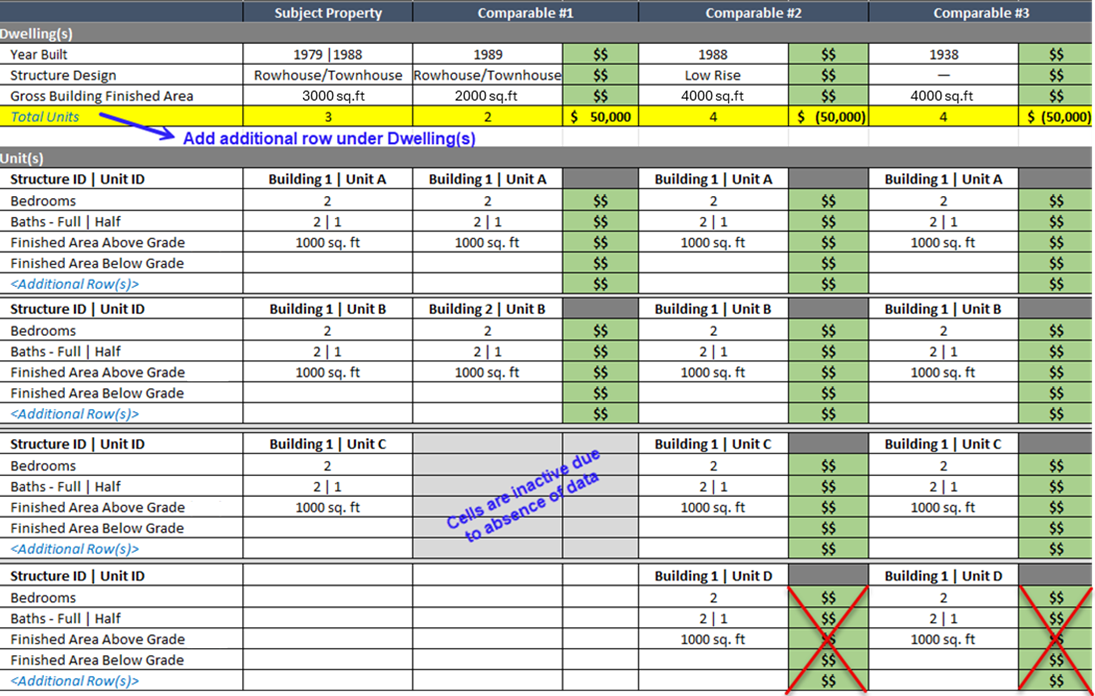
When a comparable either has fewer units or has additional units compared to the subject, the appraiser should use an <Additional Row> under the Dwelling(s) subsection of the Sales Comparison Approach and label it “Total Units”. This row should display the number of units for the subject and each comparable.
Adjustments for differences in the total number of units should be made on the “Total Units” highlighted in yellow line in the Dwelling(s) subsection. For variations at the feature level (such as a one bedroom unit compared with a two bedroom unit) apply the appropriate adjustment to the corresponding line item within the “Unit(s)” subsection of the Sales Comparison Approach. However, the appraiser should be mindful to not also double-adjust unit characteristics when a unit-based adjustment has already been applied (which is highlighted below with red X’s).
If a ceiling isn’t completely flat or has minor slopes or varying pitches, how should it be measured, and what ceiling style should be reported?
Measure the ceiling height at its highest point, consistent with standard measurement practice. For labeling, choose the ceiling style that most accurately reflects its overall design using the options in the UAD Reference Guide. Select the style that best aligns with the predominant ceiling shape. When none of the available types properly describe the ceiling select “Other” and provide a description.
Subscription Center
Get and stay connected with Freddie Mac Single-Family. Subscribe to our emails and we'll send the information that you want straight to your email inbox.